
By Joanna Booher, RDH | 25+ years in dentistry | Airway educator with Awaken2Sleep
If your husband snores loudly enough that you lie awake counting the minutes until morning, I want you to know two things right away. First, you are not being dramatic, and you are not alone. Second, that noise may be telling you something important about his health, not just ruining your night. I have spent more than 25 years in dentistry and years teaching airway health, and some of the most tired people who sit in my chair are not the snorers. They are the people sleeping next to them.
This article is written for you, the partner. I’ll talk honestly about how to get some sleep tonight, when snoring is a warning sign, how to bring it up without a fight, and what actually happens if he agrees to get checked. (And yes, plenty of wives snore too. If the roles are reversed in your house, everything here still applies.)
When Your Husband Snores Loudly, You Both Lose Sleep
Snoring is the sound of air squeezing through a narrowed airway. During sleep, the muscles in the throat relax, the tongue falls back, and the soft tissue at the back of the mouth starts to vibrate. The narrower the space, the louder and harsher the sound.
Here’s what most couples miss: the person snoring is often sleeping poorly too. He may not remember waking up, but his body may be working hard all night just to keep air moving. Meanwhile, you are the one who hears every minute of it. So you end up with two exhausted people, and only one of them knows it.
Many partners tell me they’ve tried everything. Nudging him onto his side. A new pillow. Nasal strips from the drugstore. Going to bed an hour early so they can fall asleep first. Sometimes those things help a little. But when a husband snores loudly night after night, year after year, it’s worth asking a bigger question.
Snoring or Sleep Apnea? What to Listen For
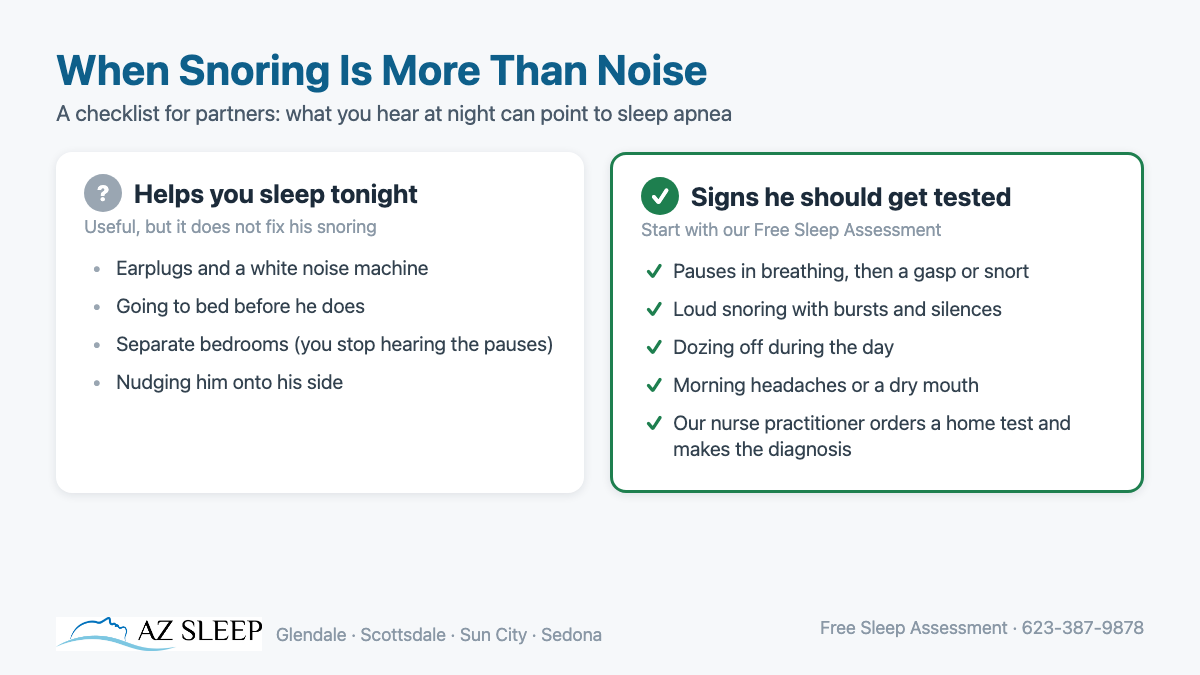
Not everyone who snores has sleep apnea. Some people have what’s called simple or primary snoring: noisy, annoying, but without the breathing interruptions that harm health. Others have obstructive sleep apnea (OSA), where the airway narrows so much that breathing actually stops or becomes very shallow, over and over, all night long.
You can’t diagnose him from your side of the bed. But you are in the best position of anyone to notice the warning signs. The American Academy of Sleep Medicine’s patient guide to snoring describes many of the same signs I ask partners about. Pay attention if you notice:
- Pauses in his breathing. The snoring stops, the room goes quiet, and then he snorts, gasps, or chokes as breathing restarts.
- Loud, irregular snoring. Not a steady rumble, but a pattern of loud bursts and silences.
- Restless sleep. Tossing, turning, kicking, or getting up to use the bathroom several times a night.
- Daytime sleepiness. Dozing off in front of the TV, in the recliner, or worse, behind the wheel.
- Morning headaches or a dry mouth. He wakes up feeling worse than when he went to bed.
- Mood changes. More irritable, forgetful, or short on patience than he used to be.
If several of those sound familiar, his snoring deserves a real evaluation, not just another pillow. Our sleep apnea checklist is a simple way to go through the signs together.
Why the Pauses Matter
Each time breathing stops, oxygen levels can drop and the brain jolts the body awake just enough to reopen the airway. He may never remember it. But over months and years, untreated sleep apnea is linked to high blood pressure, heart disease, stroke, and daytime accidents. That is why I tell partners that your observations are valuable medical information. You might be the only witness.
Why Your Own Exhaustion Matters Too
I want to pause here and talk about you. When you lose sleep night after night, it affects your mood, your memory, your patience, and your health. Chronic poor sleep is not a small thing, no matter whose snoring causes it.
A lot of women I talk with have quietly accepted years of broken sleep because they didn’t want to hurt their husband’s feelings or seem like they were complaining. Some have started to feel resentful and then guilty about feeling resentful. If that’s you, please hear this: wanting to sleep is not selfish. Looking after your own rest is part of looking after your marriage.
And one more honest note. If you are tired all the time even on nights when the house is quiet, it’s worth considering your own sleep too. Sleep apnea in women often looks different and gets missed. I wrote more about that in sleep apnea in women: why thin women get missed.
Getting Through Tonight: What Honestly Helps
While you work on the bigger picture, you still need to sleep. Here are the options partners use, with my honest take on each.
Earplugs and White Noise
Foam or silicone earplugs can take the edge off, especially combined with a fan or a white noise machine. They won’t block every sound, and some people find them uncomfortable. They also don’t help him at all. Think of them as a tool to get you through the night, not a solution.
Going to Bed First
Falling asleep before the snoring starts works for some partners, at least for part of the night. The problem is that many people wake up in the early morning hours and then can’t fall back asleep once the noise is in full swing.
Separate Bedrooms
Let’s talk about this one honestly, because a lot of couples feel embarrassed by it. When a husband snores loudly every single night, moving to another room can feel like the only way left to get any rest. Sleeping in separate rooms is more common than people admit, and for some couples it genuinely saves their sleep and their mood. There’s no shame in it.
But it comes with a catch. When you leave the room, you also stop hearing the pauses and gasps. The snoring didn’t go away; you just can’t hear it anymore. If his snoring is a sign of sleep apnea, moving down the hall solves your problem while his keeps going. So by all means, protect your sleep. Just don’t let the guest room become the reason nobody ever gets him checked.
Side Sleeping and Avoiding Alcohol Before Bed
For some people, snoring is worse on their back and after alcohol in the evening, because alcohol relaxes the throat muscles even more. Helping him stay on his side and skipping that nightcap can make a difference for some snorers. If it helps a lot, great. If it doesn’t, that’s another clue that something more is going on.

How to Bring It Up Without Starting a Fight
This is the part partners worry about most. Even when your husband snores loudly enough to rattle the windows, snoring is a touchy subject. Some men laugh it off, some get defensive, and some honestly don’t believe it’s as loud as you say. Here’s what I’ve seen work:
- Pick a calm moment. Not at 2am when you’re both frustrated. Bring it up over coffee or on a walk.
- Lead with worry, not blame. “I’m worried about you. Sometimes you stop breathing at night and it scares me” lands very differently than “Your snoring is driving me crazy.”
- Share what you’ve seen. Describe the pauses, the gasps, the way he nods off in the afternoon. Specifics are hard to argue with.
- Consider a recording. Some couples record a minute or two of snoring on a phone. A snoring app or recording is not a diagnosis, but hearing it can open a stubborn person’s mind.
- Connect it to what he cares about. His energy, his blood pressure, being sharp at work, being around for the grandkids.
- Make the first step small. Suggest he take a short online questionnaire, not “go see a sleep specialist.”
That last point is important. Asking someone to fill out a quick questionnaire is a much easier yes than asking them to commit to a big medical process.
What Happens When He Agrees to Get Checked
Here is exactly how the process works at AZ Sleep, so you can tell him what to expect. There are no surprises and no overnight lab required for most people.
- Free Sleep Assessment. He starts with our Free Sleep Assessment, a short online screening questionnaire, or he can call us at 623-387-9878.
- Visit with our nurse practitioner. Next is a visit with our nurse practitioner. This is a medical visit billed under his medical insurance, and we accept Medicare and medical insurance. Only a medical provider can prescribe a sleep study; dentists cannot.
- Home sleep test. Our nurse practitioner orders a disposable, FDA-cleared home sleep test. He sleeps with it in his own bed, and he keeps the device. There’s nothing to return.
- Diagnosis. Our nurse practitioner reviews the results and makes the diagnosis. That tells you whether this is simple snoring or sleep apnea, and if it’s apnea, how severe.
- Complimentary dental consult, only after diagnosis. If oral appliance therapy may be a good fit, he meets with our dental sleep team for a complimentary consult.
- Custom appliance and follow-up test. If he moves forward, we make a custom oral appliance and then do a follow-up test to confirm it’s working.
For a lot of men, the home sleep test is what makes them say yes. No lab, no wires all over the head, no strange bed. Just one night at home.
Tired of lying awake listening to the snoring?
If your husband snores loudly, the first step is easier than you think: a short online questionnaire, then a visit with our nurse practitioner at any of our four Arizona locations. Medicare and medical insurance accepted.
Call 623-387-9878 or take your Free Sleep Assessment.
If It Is Sleep Apnea, What Are the Options?
If our nurse practitioner diagnoses sleep apnea, there is more than one way to treat it. The right choice depends on how severe it is, his anatomy, his health, and what he will actually use every night.
- CPAP. A machine that gently pushes air through a mask to keep the airway open. It works very well when it’s used consistently, and it is usually the first choice for severe sleep apnea. The challenge is that some people struggle to tolerate the mask.
- Custom oral appliance. A small device, similar to a mouthguard, that holds the lower jaw slightly forward so the airway stays open. Oral appliance therapy is recommended by the American Academy of Sleep Medicine for mild to moderate obstructive sleep apnea and for people who can’t tolerate CPAP. It’s quiet, portable, and there’s no hose.
- Other approaches. Weight loss, positional therapy, Inspire (an implanted nerve stimulator) and certain surgeries can be options for the right patient.
You can read more about each one on our sleep apnea treatment options page.
And If It’s Simple Snoring?
Good news: that’s a real answer too. If the test shows he doesn’t have sleep apnea, a custom oral appliance can often quiet primary snoring by giving air more room to move. I go deeper on that in my article on snoring treatment that goes beyond strips and sprays. The key is that we test first, so we know we’re treating the right problem.
Many partners tell me that the first quiet night is the moment they realize how much sleep they had been missing for years. That’s the goal: two people actually resting.
Frequently Asked Questions
Is loud snoring always a sign of sleep apnea?
No. Some people snore loudly without having sleep apnea. But loud snoring with pauses in breathing, gasping, or daytime sleepiness is a strong reason to get tested. Only a sleep test can tell the difference, and our nurse practitioner is the one who makes that diagnosis.
My husband refuses to get checked. What can I do?
Start small and lead with concern rather than frustration. Share specific things you’ve noticed, and ask him to take a short online questionnaire instead of committing to a big appointment. Sometimes hearing a short recording of his own snoring helps him take it seriously.
Can a snoring app or smartwatch tell us if he has sleep apnea?
No. Apps and wearables can record sound or estimate sleep, but they are not a diagnosis. A prescribed home sleep test, ordered and reviewed by our nurse practitioner, is what tells you whether it’s sleep apnea.
Are separate bedrooms a bad idea?
Not at all. For many couples, separate rooms protect sleep and keep the peace. Just don’t let it replace getting his snoring evaluated, because you’ll no longer hear the pauses and gasps that point to sleep apnea.
Does the home sleep test have to be returned?
No. We use a disposable, FDA-cleared home sleep test that he keeps. He sleeps with it in his own bed, and our nurse practitioner reviews the results with him.
You both deserve a good night’s sleep.
If your husband snores loudly, find out what’s behind it. Take your Free Sleep Assessment, or call 623-387-9878 to schedule with our nurse practitioner at any of our four Arizona locations.
Want to keep learning first? Browse our patient education library for more plain-English answers about sleep and airway health.
Snoring is easy to joke about until you’re the one lying awake at 3am. If you’ve been quietly putting up with it for years, consider this your permission to speak up, for his health and for your own rest. One short questionnaire could be the start of quieter nights for both of you.
Ready to find out what’s happening with your sleep?
It starts with our Free Sleep Assessment: a few quick screening questions, at no cost and with no referral needed. Medicare and medical insurance accepted.
Free Sleep Assessment
or call 623-387-9878 · Glendale · Scottsdale · Sun City · Sedona

Author: Joanna Booher, RDH
25+ years in dentistry · Airway educator with Awaken2Sleep · Licensed Dental Hygienist, AZ #H05418 (verify) · LinkedIn