
By Joanna Booher, RDH | 25+ years in dentistry | Airway educator with Awaken2Sleep
When a patient settles into my chair and I see dry, sticky tissue, puffy gums along the front teeth, and lips that are a little chapped, I often ask the same thing: “Do you wake up with a dry mouth?” The answer is almost always yes. Mouth breathing at night is one of the most common things I notice as a hygienist, and one of the most overlooked. Most people think of it as a harmless habit. I’ve learned it’s often a clue about how well you’re breathing, and sleeping, every single night.
In this article I’ll walk you through how to tell if you breathe through your mouth while you sleep, why it matters for your teeth, gums, and overall rest, what commonly causes it, and which fixes are worth trying. I’ll also be honest about the popular trends that I’d approach with caution.
How to Tell If You’re Breathing Through Your Mouth While You Sleep
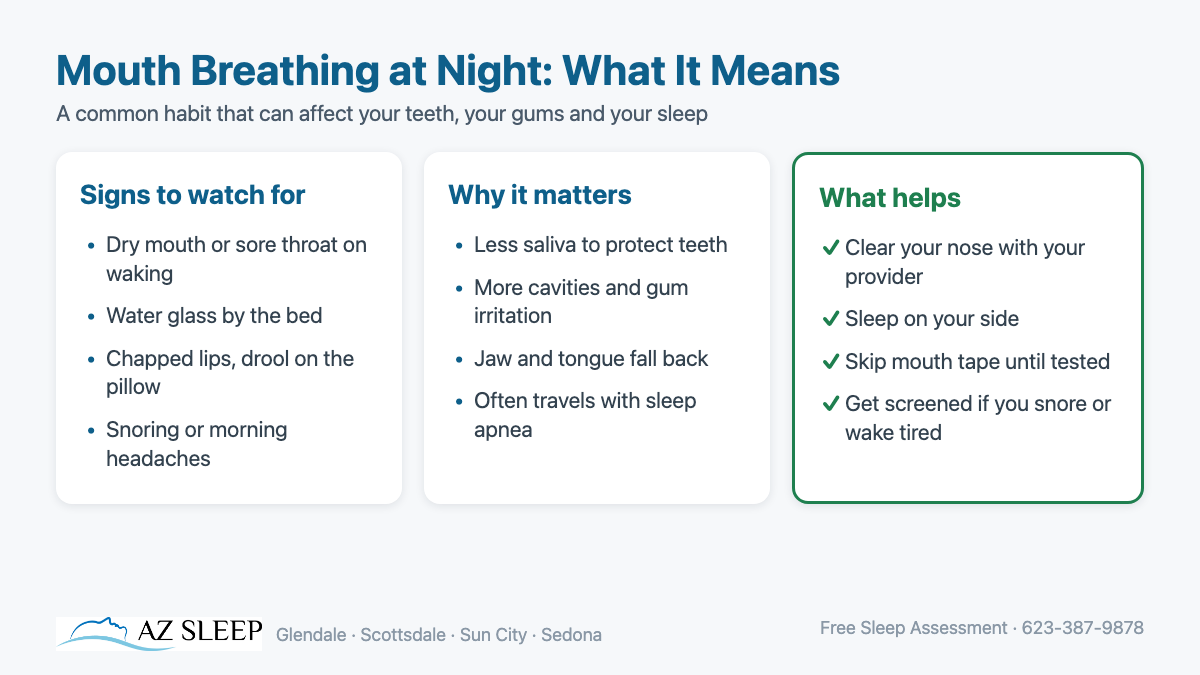
Since you’re asleep when it happens, you have to look for the evidence. These are the signs patients describe to me most often:
- Waking up with a dry mouth, a dry or scratchy throat, or a tongue that feels like sandpaper
- Keeping a glass of water on the nightstand and reaching for it during the night
- Bad breath in the morning that seems stronger than it should be
- Chapped or cracked lips, especially in the corners
- Drool on the pillow
- Snoring, which a partner may describe as loud or open mouthed
- Waking up with a stuffy nose or a headache
- Feeling tired in the morning even after a full night in bed
From the dental side, I may also see more plaque and inflammation along the front gums, more cavities than your brushing habits would explain, and tissues that look dry instead of moist and healthy.
Why Mouth Breathing at Night Matters
Your nose is built for breathing. It filters, warms, and humidifies the air before it reaches your lungs. Your mouth is built for eating and talking. When you breathe through your mouth for hours every night, a few things happen.
It dries out your mouth
Saliva is one of your body’s best defenses for your teeth. It rinses away food particles, helps neutralize acids, and carries minerals that help protect enamel. When air is moving across your teeth and gums all night, saliva evaporates and that protection drops. That’s why I see more cavities, especially along the gumline, and more gum irritation in people who breathe through their mouths while they sleep.
It’s tied to snoring
When your mouth falls open during sleep, your lower jaw tends to drop back, and your tongue can move back with it. That can narrow the space in your throat. Snoring is the sound of air squeezing through that narrowed space and vibrating the soft tissues.
It can be a sign of sleep apnea
Here’s the part I most want you to know. Mouth breathing doesn’t automatically mean you have sleep apnea. But it often shows up alongside it. In obstructive sleep apnea, the airway narrows or collapses during sleep, breathing pauses or becomes shallow, and the brain briefly rouses you to start breathing again. People with a blocked nose or a crowded airway often open their mouths to get more air, and that open position can make the airway even less stable.
If your mouth breathing comes with loud snoring, gasping, morning headaches, or daytime exhaustion, I want you screened. Our obstructive sleep apnea page explains the condition in more detail.
Common Causes of Breathing Through Your Mouth at Night
When mouth breathing at night becomes a nightly pattern, there’s usually a reason the mouth takes over. Some of the most common ones include:
- Nasal congestion. Colds, seasonal allergies, dust, and dry air can all leave the nose stuffy, especially overnight when you’re lying down.
- Structural issues in the nose. A deviated septum, enlarged turbinates (the tissues inside the nose that warm the air), or nasal polyps can make nose breathing harder.
- A crowded airway. A large tongue relative to the space in your mouth, a small or set back jaw, or large tonsils can make it feel easier to breathe through the mouth.
- Sleep position. Sleeping flat on your back lets gravity pull the jaw and tongue backward.
- Habit. Some people breathed through their mouths as children because of allergies or large adenoids, and the pattern stuck.
- Sleep apnea itself. When the airway keeps collapsing, the body may open the mouth as it struggles to get air.
Many patients have more than one of these going on. That’s why I’m wary of any single quick fix that promises to solve it for everyone.
What Actually Helps Mouth Breathing at Night
The best approach depends on why it’s happening. Here’s how I talk patients through it.
Start with your nose
If your nose is congested, it’s hard to breathe through it no matter how much you want to. Talk with your medical provider about allergies or chronic congestion. Simple steps like saline rinses, keeping your bedroom clean and dust free, and running a humidifier in a dry climate can make a real difference for some people. If you suspect a structural problem, an ear, nose and throat specialist can take a look.
Change your sleep position
Sleeping on your side can help keep the jaw and tongue from falling back. Some people find a supportive pillow behind the back helps them stay there.
Protect your teeth and gums
While you sort out the cause, protect your mouth. Brush and floss carefully before bed, ask your dentist whether a fluoride toothpaste or rinse makes sense for you, sip water, and avoid sugary drinks or mints at night. Keep up with your cleanings so we can catch gum irritation and early cavities.
Be cautious with mouth taping
Mouth taping has become popular online. I understand the appeal, but I want to be careful here. Taping your mouth shut does not treat a blocked nose, a crowded airway, or sleep apnea. If you have undiagnosed sleep apnea, closing off your mouth without knowing what’s happening in your airway isn’t something I’d recommend. Please talk with a medical provider before trying it, and never use it as a substitute for testing.
Chin straps and CPAP masks
Chin straps are sometimes used with CPAP to keep the mouth closed, and people who breathe through their mouths on CPAP may do better with a full face mask. Those decisions belong with your sleep provider, because they depend on your diagnosis and your equipment.
Oral appliance therapy, when it fits
If you’re diagnosed with obstructive sleep apnea, a custom oral appliance is one treatment option. It fits over your upper and lower teeth and holds your lower jaw slightly forward, which helps keep the airway open. The American Academy of Sleep Medicine recognizes oral appliances as a treatment for mild to moderate obstructive sleep apnea and for people who can’t tolerate CPAP. For severe sleep apnea, CPAP is usually the first recommendation. You can compare choices on our sleep apnea treatment options page.
Waking up with a dry mouth? Find out what’s behind it.
Mouth breathing at night can be one of the earliest clues of a sleep breathing problem. Take your Free Sleep Assessment, or call 623-387-9878 to schedule with our nurse practitioner at any of our four Arizona locations.
We accept Medicare and medical insurance. Hours are Monday through Thursday, 9am to 5pm.

When Mouth Breathing Means It’s Time to Get Tested
I’d encourage you to get screened for sleep apnea if your nighttime mouth breathing comes with any of these:
- Loud snoring most nights
- A partner who has noticed you stop breathing, choke, or gasp
- Waking up unrefreshed, or needing naps to get through the day
- Morning headaches
- Trouble concentrating or remembering things
- High blood pressure
- Waking up several times a night to use the bathroom
The National Heart, Lung, and Blood Institute has a clear overview of sleep apnea symptoms and risks if you’d like to read more. A smart ring, watch, or snoring app may give you hints, but none of them is a diagnosis.
How We Find Out If Mouth Breathing at Night Is Sleep Apnea
As a hygienist, I can notice the signs, but I can’t diagnose sleep apnea, and neither can a dentist. Diagnosis is medical. Here’s the order we follow with every patient:
- Free Sleep Assessment. A short online screening questionnaire on our Free Sleep Assessment page, or a call to 623-387-9878.
- A visit with our nurse practitioner. This is a medical visit, billed under your medical insurance. Only a medical provider can prescribe a sleep study; dentists cannot.
- A home sleep test. You sleep in your own bed with a disposable, FDA-cleared device that you keep. Nothing to return. Our home sleep test page explains what the night looks like.
- Your diagnosis. Our nurse practitioner reviews your results, makes the diagnosis, and explains what your numbers mean.
- A complimentary consult, only after diagnosis. If you’re diagnosed with sleep apnea and an oral appliance may be a fit, you’ll have a complimentary consultation with our dental sleep team about oral appliance therapy.
- Your custom appliance and a follow-up test. If you go ahead, we make and adjust your appliance, then do a follow-up sleep test to confirm it’s working.
If testing shows you don’t have sleep apnea, we’ve still learned something useful. Then the focus can shift to your nose, your allergies, or your habits, with confidence that your airway isn’t collapsing at night.
What I See in Patients Who Fix Their Breathing
I won’t tell you stories I can’t back up, but I can tell you what I notice in general. When people breathe better at night, their mouths often look healthier. Tissues are less dry, the gums along the front teeth are calmer, and patients tell me they wake up without that desperate reach for water.
Your mouth is connected to everything else. The same airway that affects your gums affects your energy, your mood, and your heart. It’s also worth knowing that heavy grinding often travels with sleep breathing problems; I explain that in my article on teeth grinding and sleep apnea.
Frequently Asked Questions
Is mouth breathing at night bad for your teeth?
It can be. Breathing through your mouth dries out saliva, which normally helps protect your teeth and gums. Over time, that dryness can contribute to cavities, gum inflammation, and bad breath. Good home care and regular cleanings help, but finding the cause matters most.
Does mouth breathing mean I have sleep apnea?
Not always. Allergies, a stuffy nose, or simple habit can cause it. But mouth breathing often shows up alongside sleep apnea, so if you also snore, wake up tired, or have morning headaches, it’s worth getting screened. Our nurse practitioner can order a home sleep test and make the diagnosis.
Should I try mouth taping?
Please talk with a medical provider first. Mouth taping doesn’t treat a blocked nose or sleep apnea, and if you have undiagnosed sleep apnea, it isn’t something I’d recommend trying on your own. Testing comes first.
Can an oral appliance help with mouth breathing?
A custom oral appliance is a treatment for diagnosed obstructive sleep apnea. It holds the lower jaw forward to help keep the airway open. Whether it’s right for you depends on your diagnosis, which is why we only talk about appliances in a complimentary consult after our nurse practitioner has diagnosed you.
Will insurance cover the testing?
We accept Medicare and medical insurance. Your visit with our nurse practitioner is billed under your medical insurance, and our team will help you understand your coverage before you test.
A dry mouth in the morning is easy to ignore. I hope you won’t. Take the Free Sleep Assessment, find out what your breathing is doing at night, and give your mouth, and the rest of you, a better night’s rest.
Ready to find out what’s happening with your sleep?
It starts with our Free Sleep Assessment: a few quick screening questions, at no cost and with no referral needed. Medicare and medical insurance accepted.
Free Sleep Assessment
or call 623-387-9878 · Glendale · Scottsdale · Sun City · Sedona

Author: Joanna Booher, RDH
25+ years in dentistry · Airway educator with Awaken2Sleep · Licensed Dental Hygienist, AZ #H05418 (verify) · LinkedIn