
By Joanna Booher, RDH | 25+ years in dentistry | Airway educator with Awaken2Sleep
If you’ve typed why am I tired all the time into a search bar at two in the afternoon, you’re in good company. I hear some version of that question in the dental chair constantly. Patients tell me they go to bed at a reasonable hour, sleep what looks like a full night, and still wake up feeling like they ran a marathon in their dreams. Coffee helps for an hour. Then the fog rolls back in.
After more than 25 years in dentistry and years teaching airway health through Awaken2Sleep, I’ve learned that the mouth often tells part of the story before anyone else asks the right questions. In this article I’ll walk you through eight sleep-related causes of constant tiredness that I look for first, what each one tends to look like, and how to get real answers instead of guessing.
Why Am I Tired All the Time? Start With the Quality of Your Sleep
Most people measure sleep in hours. That’s a good start, but it’s only half of the picture. You can spend eight hours in bed and get far less restorative sleep than you think if something keeps interrupting it all night long.
Your brain needs to cycle through lighter sleep, deep sleep and dream sleep several times a night. Every time your breathing struggles, your legs kick, or acid creeps up your throat, your brain may pull you briefly toward wakefulness. You usually don’t remember these moments. You just wake up feeling unrested and wonder why.
That’s why “I sleep eight hours” doesn’t rule anything out. When a patient asks me why am I tired all the time, my first thought isn’t “you need more sleep.” It’s “I wonder what’s happening during the sleep you’re already getting.”
The 8 Sleep-Related Causes I Check First
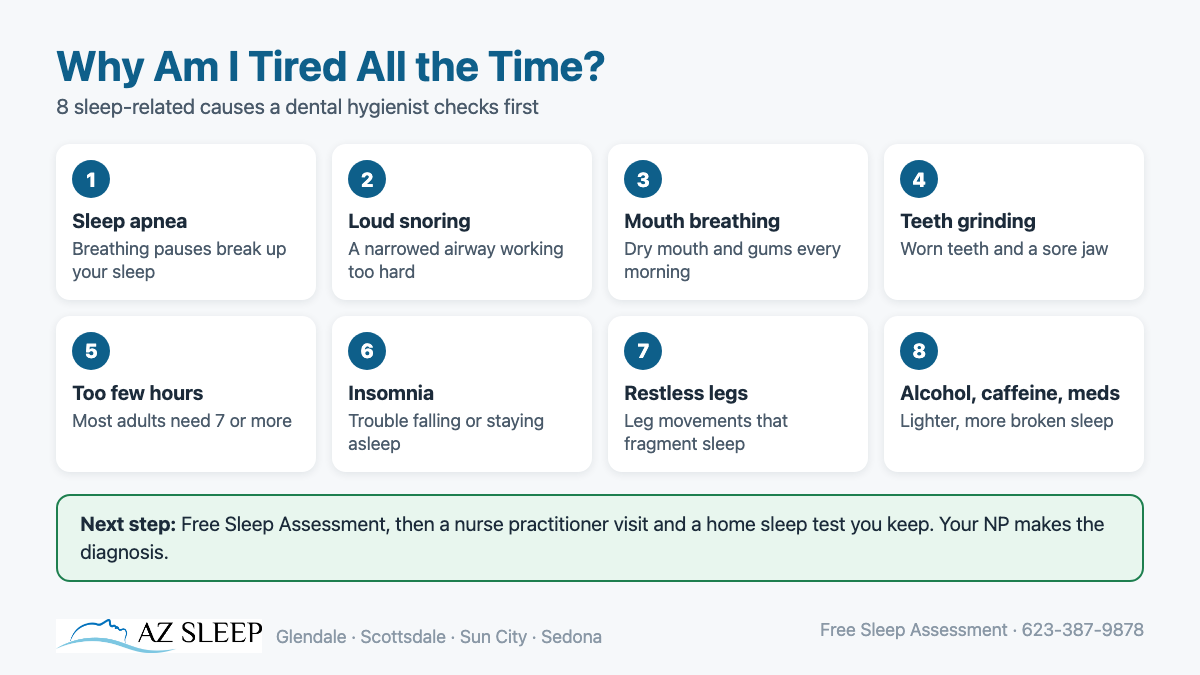
None of these are a diagnosis on their own. They’re the patterns I notice, the questions I ask, and the reasons I sometimes gently suggest a patient look into their sleep. Here they are, roughly in the order I think about them.
1. Obstructive sleep apnea
This is the big one, and it’s the one most often missed. With obstructive sleep apnea, the soft tissues of the throat relax during sleep and partly or fully block the airway. Breathing slows or stops, oxygen levels can dip, and the brain jolts you just awake enough to start breathing again. That cycle can repeat many times an hour, every night.
The result is sleep that looks complete from the outside but is broken into pieces on the inside. Common signs include loud snoring, pauses in breathing that a partner notices, waking up gasping, morning headaches, a dry mouth on waking, and needing to get up to use the bathroom at night. The American Academy of Sleep Medicine’s patient guide to obstructive sleep apnea is a good plain-language overview if you want the background.
Here’s what surprises people: you don’t have to be overweight, older, or male to have it. Some of the most worn out patients I’ve met were slim women who never thought of themselves as snorers.
2. Snoring and partial airway narrowing
Snoring is the sound of air squeezing through a narrowed airway. Sometimes it’s simple snoring and nothing more. But a narrowed airway can still make your body work harder to breathe, and a lot of loud, nightly snoring turns out to be sleep apnea once it’s tested.
I never assume snoring is harmless, and I never assume it’s sleep apnea either. The only way to know is a proper sleep test ordered by a medical provider.
3. Mouth breathing at night
As a hygienist, I can often spot a nighttime mouth breather before they say a word. Dry, irritated gums along the front teeth, more plaque and inflammation than their brushing habits would explain, cracked lips, and a dry mouth first thing in the morning are all clues.
Breathing through your mouth at night can be a sign that your nose is congested or that your airway is working harder than it should. It also tends to go hand in hand with snoring. It isn’t a diagnosis, but it’s one of the things that makes me ask more questions about how someone sleeps.
4. Teeth grinding and clenching
Flattened, chipped or worn teeth, sore jaw muscles in the morning, and tiny cracks in the enamel tell me someone may be grinding or clenching at night. Stress plays a role for many people. But grinding during sleep has also been linked with breathing disturbances, and some researchers think clenching may be one way the body responds when the airway narrows.
That doesn’t mean every grinder has sleep apnea. It does mean worn teeth plus daytime exhaustion is a combination worth taking seriously.
5. Simply not getting enough sleep
Let’s be honest about the simplest answer. Adults generally need seven or more hours of sleep a night, and many of us don’t come close. Late screens, early alarms, caregiving, shift work and long commutes all chip away at sleep time.
If you’re regularly getting five or six hours and feeling tired, the fix might be as simple (and as hard) as protecting your bedtime. But if you’re truly giving yourself seven to nine hours and still dragging, something else is likely going on.
6. Insomnia
Insomnia means trouble falling asleep, staying asleep, or waking too early and not being able to drift back off, even when you have the chance to sleep. It’s common, especially during stressful seasons of life and during menopause.
One thing I want every reader to know: insomnia and sleep apnea can exist together. Waking up repeatedly in the night is sometimes blamed on “just insomnia” when a breathing problem is part of what’s waking you. That’s one more reason testing matters.
7. Restless legs and leg movements during sleep
Restless legs syndrome causes an uncomfortable urge to move your legs, usually in the evening or when you lie down. Some people also have repeated leg movements during sleep that they never notice, though their partner might. Both can fragment sleep and leave you tired.
This isn’t something I can see in your mouth, but I ask about it, because it’s worth mentioning to a medical provider. Low iron is one of the things providers often check when restless legs are part of the picture.
8. Alcohol, caffeine and medications
A glass of wine may help you fall asleep faster, but alcohol tends to make the second half of the night lighter and more broken. It also relaxes the muscles of the throat, which can make snoring and sleep apnea worse. Caffeine late in the day can linger for hours and quietly steal deep sleep.
Some medications, including certain sleep aids, pain medications and allergy medications, can affect sleep quality or breathing at night. Never stop a prescription on your own, but do bring the full list to your medical provider if you’re constantly exhausted.
Tiredness That Isn’t About Sleep at All
I’d be doing you a disservice if I pretended every case of fatigue comes from the bedroom. Feeling tired all the time can also be connected to thyroid problems, anemia, blood sugar issues, depression, vitamin deficiencies, heart conditions and other medical causes.
So if you’re wondering why am I tired all the time, I always encourage you to keep your primary care provider in the loop. Routine bloodwork can rule out a lot. And when that bloodwork comes back normal and you’re still exhausted, it’s a strong signal to look more closely at your sleep.
Sometimes the two overlap. Untreated sleep apnea has been linked with high blood pressure, heart problems and mood changes, so the sleep question and the medical question often turn out to be the same question.

What I Notice Chairside That You Might Not
Patients are sometimes surprised that a dental hygienist would bring up sleep. But we see you regularly, we look closely at your mouth, and we often know you over many years. That gives us a front row seat to small changes.
Here’s what tends to catch my attention:
- Worn or flattened teeth that suggest nighttime grinding or clenching.
- A scalloped tongue, with ridges along the sides where it presses against the teeth, which can suggest the tongue is crowded in the mouth.
- Large tonsils or a crowded throat when I look toward the back of the mouth.
- Dry, inflamed gums that point to mouth breathing.
- A recessed lower jaw or narrow palate, which can leave less room for the airway.
- Patients who nod off in the chair during a routine cleaning. It happens more than you’d think.
None of these findings diagnose anything. A dental team cannot diagnose sleep apnea. What we can do is notice, ask, and point you toward the right next step.
Quick Self Check: Could Your Tiredness Be Sleep Related?
Ask yourself these questions honestly. If several sound familiar, it’s worth getting checked.
- Has anyone told you that you snore loudly, or that you stop breathing or gasp in your sleep?
- Do you wake up with a dry mouth, a sore throat or a headache?
- Do you get up to use the bathroom more than once a night?
- Do you fall asleep easily when you sit still, like in a waiting room, a movie, or a passenger seat?
- Do you feel foggy, forgetful or irritable during the day?
- Have you been told you have high blood pressure that’s hard to control?
- Do you grind your teeth, or has your dentist mentioned wear?
For a longer list, our sleep apnea checklist walks through more of the warning signs. And if waking up short of breath is part of your story, read my article on waking up gasping for air.
One note on smart rings, watches and snoring apps: they can be interesting, and they may prompt a useful conversation. But they are not a diagnosis, and a normal looking score on a gadget doesn’t rule out sleep apnea.
How to Get Real Answers About Your Fatigue
If you’re asking why am I tired all the time and sleep might be part of the answer, here’s exactly how the process works with us. It’s the same at every one of our four Arizona locations.
- Free Sleep Assessment. Start with our short online screening questionnaire at our Free Sleep Assessment page, or call 623-387-9878 and we’ll go through it with you.
- Visit with our nurse practitioner. This is a medical visit, billed under your medical insurance. Only a medical provider can prescribe a sleep study; dentists cannot. Our nurse practitioner reviews your symptoms and history and orders your test if it makes sense.
- Home sleep test. You sleep in your own bed with a disposable, FDA-cleared device. It’s yours to keep, so there’s nothing to return. Learn more on our home sleep test page.
- Diagnosis. Our nurse practitioner reviews the results with you and makes the diagnosis.
- Complimentary consult, only after diagnosis. If you’re diagnosed with sleep apnea and an oral appliance might be a fit, you’ll meet with our dental sleep team for a complimentary consultation.
- Custom appliance and follow-up test. If you move forward, we make a custom oral appliance and then test again to confirm it’s working.
We accept Medicare and medical insurance. Our offices are open Monday through Thursday, 9am to 5pm.
And if your test shows you don’t have sleep apnea? That’s a real answer too. It helps you and your primary care provider focus on what else might be behind your fatigue.
Frequently Asked Questions
Why am I tired all the time even though I sleep eight hours?
Hours in bed don’t guarantee good sleep. Conditions like obstructive sleep apnea, restless legs, or alcohol close to bedtime can break your sleep into pieces without fully waking you. Medical causes like thyroid problems or anemia can also play a role, so it’s worth talking with a medical provider.
Can a dentist or hygienist diagnose sleep apnea?
No. Dental teams often notice signs like worn teeth, a scalloped tongue or mouth breathing, but only a medical provider can order a sleep study and make a diagnosis. At AZ Sleep, that’s our nurse practitioner.
Is constant tiredness always a sleep problem?
Not always. Fatigue can come from many medical causes, including thyroid issues, anemia, depression and blood sugar problems. Sleep is one of the first places to look, especially if you snore, wake up unrefreshed, or a partner has noticed breathing pauses.
Can my smartwatch tell me if I have sleep apnea?
A smartwatch, ring or app is not a diagnosis. It may hint that something is off, but only a prescribed sleep test reviewed by a medical provider can tell you whether you have sleep apnea and how severe it is.
What happens if my home sleep test is normal?
That’s useful information. It means a breathing problem during sleep is less likely to be the cause, and you and your medical providers can focus on other possible reasons for your fatigue.
Tired of being tired? Find out if sleep is the reason.
A few minutes now could answer a question you’ve been asking for years. Take your Free Sleep Assessment, or call 623-387-9878 to schedule with our nurse practitioner at any of our four Arizona locations.
Want to keep learning first? Browse our patient education library for more plain-English answers about sleep and airway health.
Being exhausted all the time is not a personality trait, and it’s not something you just have to accept as part of getting older or being busy. Your body is trying to tell you something. Listen to it. Ask “why am I tired all the time?” out loud, to people who can actually answer it, and let us help you find out.
Ready to find out what’s happening with your sleep?
It starts with our Free Sleep Assessment: a few quick screening questions, at no cost and with no referral needed. Medicare and medical insurance accepted.
Free Sleep Assessment
or call 623-387-9878 · Glendale · Scottsdale · Sun City · Sedona

Author: Joanna Booher, RDH
25+ years in dentistry · Airway educator with Awaken2Sleep · Licensed Dental Hygienist, AZ #H05418 (verify) · LinkedIn