
By Joanna Booher, RDH | 25+ years in dentistry | Airway educator with Awaken2Sleep
If your CPAP machine is sitting in a closet, or on the nightstand with the mask pulled off at 2am, you are not alone and you are not a bad patient. CPAP is a very effective treatment for sleep apnea, but only on the nights you can actually wear it. When the mask, the hose and the air pressure just won’t work for you, it’s time to look at CPAP alternatives that are real, medically sound and matched to your diagnosis.
I’ve spent more than 25 years in dentistry, and today a big part of my work is teaching other dental teams about airway health through Awaken2Sleep. I hear the same story from CPAP strugglers almost every week. So here is my honest list of seven options, what each one is good for, and where each one falls short.
Why CPAP Is Hard for So Many People
Let me say this first: CPAP works. It blows a steady stream of air through a mask to hold your airway open while you sleep, and when it’s worn all night, every night, it is the most reliable treatment we have for moderate to severe obstructive sleep apnea. If yours is working for you, keep using it.
The problem is that many people find it very hard to live with. The reasons I hear most often are:
- The mask. It leaks, it rubs the bridge of the nose, or it feels claustrophobic.
- The air pressure. Some people feel like they’re breathing against a wind tunnel, or they swallow air and wake up bloated.
- Dryness. A dry mouth, dry nose or nosebleeds, especially in our dry Arizona air.
- The noise and the hose. Partners get woken up, and turning over means fighting the tubing.
- Travel. Packing a machine, distilled water and supplies for every trip gets old fast.
If you recognize yourself in that list, I want you to hear this: stopping CPAP without a plan leaves your sleep apnea untreated. The goal of this article is to help you find a plan you can actually stick with. If you want a deeper look at the mask and dryness issues, my article on CPAP side effects covers them in detail.
7 CPAP Alternatives at a Glance
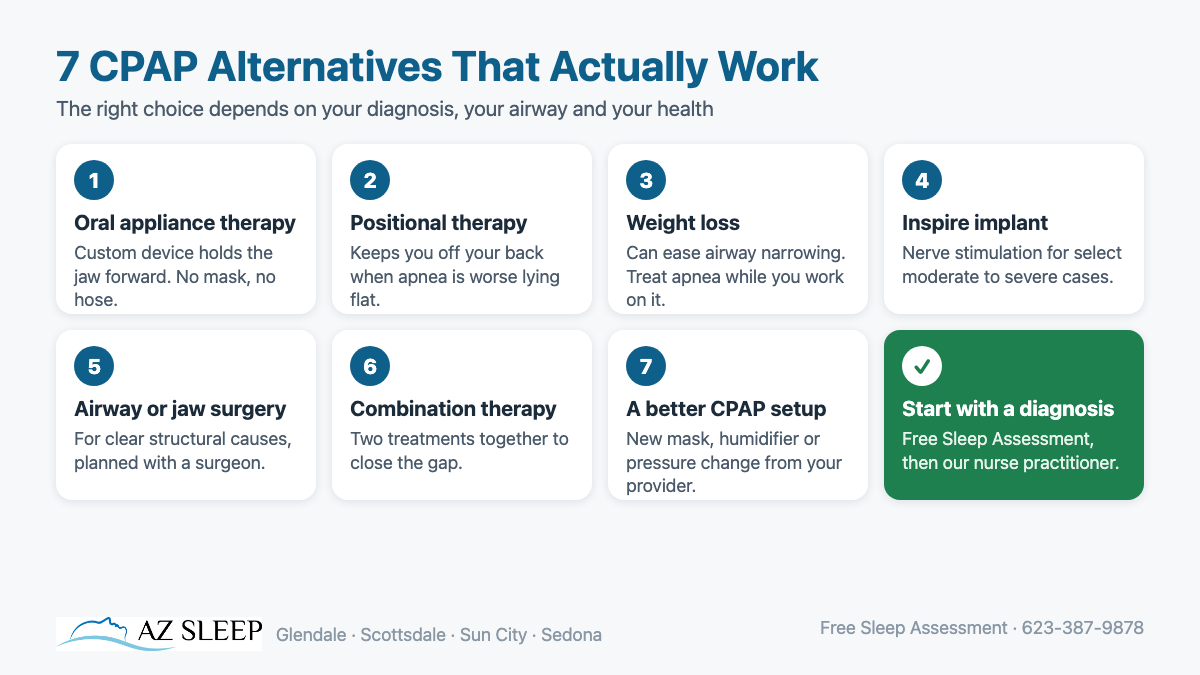
Not every option fits every person. Which one is right for you depends on how severe your sleep apnea is, the shape of your airway, your weight, your sleep position and your other health conditions. That’s why every one of these starts with a diagnosis and a conversation, not an online order.
Here’s the short version before we go deeper:
- Oral appliance therapy
- Positional therapy
- Weight loss and medical weight management
- Inspire (hypoglossal nerve stimulation)
- Airway or jaw surgery
- Combination therapy
- A better CPAP setup, or a different type of machine
Oral Appliance Therapy: The Most Common of the CPAP Alternatives
Option number one is the option I know best, and it’s the one most of our patients ask about. A custom oral appliance looks a little like a sports mouthguard or a pair of clear retainers. You wear it while you sleep, and it gently holds your lower jaw slightly forward. That small change helps keep your tongue and the soft tissues of your throat from collapsing back into your airway.
The American Academy of Sleep Medicine recommends oral appliance therapy for adults with mild to moderate obstructive sleep apnea, and for people with sleep apnea who can’t tolerate CPAP. If you have severe sleep apnea, CPAP is usually tried first, but an oral appliance can still be considered when CPAP simply isn’t working for you. The American Academy of Dental Sleep Medicine has a helpful overview of oral appliance therapy if you want to read more.
What patients like about it
- No mask, no hose and no machine noise.
- It fits in a small case, so travel is easy.
- No electricity, no distilled water, no filters to replace.
What to know honestly
- It must be custom made and adjusted by a dental sleep team. A drugstore mouthguard is not the same thing.
- Some people have jaw soreness or a change in their bite, which is why follow-up visits matter.
- You need enough healthy teeth to hold it in place.
- We confirm it’s working with a follow-up sleep test, not just by how you feel.
You can see what these devices look like on our sleep apnea devices page.
Lifestyle Options: Positional Therapy and Weight Loss
These two are the least invasive options on the list. They work best for the right person, and often alongside another treatment.
2. Positional Therapy
For some people, sleep apnea is much worse when they sleep flat on their back. Gravity pulls the tongue and jaw backward and narrows the airway. If your sleep test shows that most of your breathing events happen on your back, keeping you on your side may help a lot.
Positional therapy can be as simple as a wedge pillow or a backpack style device, or it can be a small wearable that vibrates gently when you roll onto your back. It works best for people whose apnea is clearly position dependent and on the milder side. It’s rarely enough on its own for moderate or severe sleep apnea, but it can be a useful partner to other treatments.
3. Weight Loss and Medical Weight Management
Extra weight, especially around the neck, can narrow the airway. Losing weight can reduce how often your breathing stops at night, and for some people it improves sleep apnea a great deal. Newer prescription weight loss medications have also become part of the conversation, and one has been FDA approved for moderate to severe obstructive sleep apnea in adults with obesity. That’s a decision for you and your medical provider.
Here’s the honest part. Weight loss takes time, and sleep apnea itself makes losing weight harder, because poor sleep disrupts the hormones that control hunger. That’s why I encourage patients to treat their sleep apnea now while they work on weight, not wait until after. If you are curious where you stand, a BMI check is a quick starting point.
Also worth knowing: plenty of people with sleep apnea are not overweight at all. Jaw size, tongue size and airway shape matter too.
Surgical Options: Inspire and Airway Surgery
When less invasive treatments haven’t worked, some people consider a procedure. These are bigger decisions, made with a surgeon, but you deserve to know they exist.
4. Inspire (Hypoglossal Nerve Stimulation)
Inspire is a small device implanted under the skin of the chest during an outpatient surgery. At night, it senses your breathing and gently stimulates the nerve that moves your tongue forward, which keeps the airway open. You turn it on with a remote before bed.
It’s an option for certain adults with moderate to severe obstructive sleep apnea who can’t use CPAP, and there are specific requirements for weight, sleep test results and how your airway collapses. It’s surgery, so it’s a bigger step than a mouthpiece, and it’s done by an ear, nose and throat surgeon. For the right person, though, it can be a very good choice.
5. Airway or Jaw Surgery
Some people have an anatomical reason for their sleep apnea that surgery can address. That might mean removing large tonsils, correcting a blocked nose, or in more involved cases, surgery that moves the upper and lower jaw forward to open the airway.
Surgery is usually considered when other options haven’t worked or when there’s a clear structural problem. Results vary from person to person, recovery can be significant, and it’s a decision to make carefully with a surgeon. It’s on this list for completeness, not because it’s the first stop.
Mix and Fix: Combination Therapy and a Better CPAP Setup
The last two CPAP alternatives aren’t new devices at all. They’re smarter ways to use the tools you already have.
6. Combination Therapy
Sometimes one treatment gets you most of the way, and a second one closes the gap. A few combinations we see:
- Oral appliance plus positional therapy for people whose apnea is worse on their back.
- Oral appliance plus CPAP in some cases, where the appliance may allow a lower, more comfortable CPAP pressure. That’s a medical decision your sleep provider would guide.
- Oral appliance plus weight loss, so you’re treated tonight while you work on long term health.
- Oral appliance as a travel backup for people who use CPAP at home but don’t want to pack a machine.
There’s no rule that says you have to pick only one. The best plan is the one that keeps your breathing steady all night.
7. A Better CPAP Setup, or a Different Machine
This one surprises people, but it belongs on the list. Many CPAP problems can be fixed. A different mask style, a heated humidifier, a chin strap, mask liners or a pressure adjustment from your prescribing provider can turn a miserable experience into a tolerable one.
Some people do better on an auto adjusting machine (APAP) that changes pressure through the night, and some people with specific medical needs are moved to BiPAP, which uses two different pressures. If you’re curious about the difference, read my guide on BiPAP vs CPAP. Before you give up on positive airway pressure completely, it’s worth one honest conversation about what can be adjusted.
What Doesn’t Count as a Real Alternative
I’d be doing you a disservice if I didn’t mention the things that get marketed as CPAP alternatives but aren’t treatment for sleep apnea:
- Boil and bite mouthguards from the store or online. They aren’t fitted or adjusted by anyone, they can move your teeth or strain your jaw, and they may quiet your snoring while your sleep apnea continues underneath.
- Nasal strips, sprays and mouth tape. These may help some people breathe a little easier or snore less, but they don’t treat obstructive sleep apnea.
- Smart rings, watches and snoring apps. They can track sleep trends, but they are not a diagnosis and they don’t treat anything.
The danger with all of these is false comfort. Quieter nights can hide a breathing problem that is still straining your heart and blood pressure.
How to Get Started With CPAP Alternatives at AZ Sleep
Here’s exactly how the process works with us. It’s the same order for every patient, because sleep apnea is a medical condition and the medical steps come first.
- Free Sleep Assessment. Take our short online screening questionnaire at the Free Sleep Assessment page, or call us at 623-387-9878.
- Visit with our nurse practitioner. This is a medical visit, billed under your medical insurance. Only a medical provider can prescribe a sleep study; dentists cannot.
- Home sleep test. You sleep in your own bed with a disposable, FDA-cleared device. It’s yours to keep, so there’s nothing to return.
- Diagnosis. Our nurse practitioner reviews your results and makes the diagnosis.
- Complimentary consult. Only after you’re diagnosed, you meet with our dental sleep team for a complimentary consult about whether oral appliance therapy is a good fit.
- Custom appliance and follow-up test. If it’s right for you, we make and adjust your custom oral appliance, then do a follow-up test to confirm it’s working.
We accept Medicare and medical insurance, and we see patients Monday through Thursday, 9am to 5pm, at our four Arizona locations. If oral appliance therapy isn’t the right fit, we’ll tell you honestly and point you toward the CPAP alternatives that make more sense for your situation.
Frequently Asked Questions
Is an oral appliance as good as CPAP?
CPAP is generally more effective at lowering breathing events on the nights it’s worn. But a treatment only helps when you use it, and many people wear an oral appliance more consistently than a mask. For mild to moderate sleep apnea, or for people who can’t tolerate CPAP, an oral appliance is a recommended option. A follow-up sleep test tells us how well it’s working for you.
Can I just stop using my CPAP?
Please don’t stop without a plan. Untreated sleep apnea is linked to high blood pressure, heart problems and daytime sleepiness that can make driving dangerous. Talk with your prescribing provider, and look into CPAP alternatives so there’s no gap in treatment.
Does Medicare cover CPAP alternatives?
Medicare and many medical insurance plans can cover custom oral appliances for diagnosed obstructive sleep apnea when coverage requirements are met. Coverage depends on your plan and your diagnosis, so we review it with you before treatment. We accept Medicare and medical insurance.
Do I need a new sleep test to get an oral appliance?
Oral appliance therapy requires a diagnosis of obstructive sleep apnea from a medical provider. At AZ Sleep, that path runs through our nurse practitioner visit and a home sleep test, and our nurse practitioner makes the diagnosis before you ever meet with our dental sleep team.
Will an oral appliance change my teeth?
Some people notice bite changes over time with long term use. That’s one reason a custom appliance needs a dental sleep team watching over it, with regular check-ins and adjustments. It’s also why I warn people away from unsupervised store-bought devices.
Done fighting your mask? Let’s find a plan you can keep.
The right CPAP alternative starts with an honest look at your diagnosis and your airway. Take your Free Sleep Assessment, or call 623-387-9878 to schedule with our nurse practitioner at any of our four Arizona locations.
Want to keep learning first? Browse our patient education library for more plain-English answers about sleep and airway health.
Giving up on CPAP doesn’t mean giving up on good sleep. It means finding a treatment that fits your body and your life. If you’re ready to stop fighting your nights, we’re here to help you find the option that works.
Ready to find out what’s happening with your sleep?
It starts with our Free Sleep Assessment: a few quick screening questions, at no cost and with no referral needed. Medicare and medical insurance accepted.
Free Sleep Assessment
or call 623-387-9878 · Glendale · Scottsdale · Sun City · Sedona

Author: Joanna Booher, RDH
25+ years in dentistry · Airway educator with Awaken2Sleep · Licensed Dental Hygienist, AZ #H05418 (verify) · LinkedIn