
By Joanna Booher, RDH | 25+ years in dentistry | Airway educator with Awaken2Sleep
Most people think of CPAP problems as a bedroom issue: a mask that leaks, a hose that tangles, a machine that hums. But as a dental hygienist, I often see the first signs of trouble in the dental chair. A mouth that’s bone dry, gums that are suddenly irritated, new cavities in someone who hasn’t had one in years. Those are some of the CPAP side effects that rarely get talked about, and they’re worth paying attention to.
I’ve worked in dentistry for more than 25 years and I teach airway health to dental teams through Awaken2Sleep. In this article I’ll walk you through the most common side effects of CPAP, the ones your dental team may notice before you do, and the practical fixes that help. I’ll also be honest about when it’s time to talk about other options.
First, a Word in Defense of CPAP
CPAP (continuous positive airway pressure) is a very effective treatment for obstructive sleep apnea. It sends a steady stream of air through a mask to keep your airway from collapsing while you sleep. When it’s worn every night, it lowers the number of times your breathing stops and can make a real difference in how you feel.
So this isn’t an article about why CPAP is bad. It’s an article about why some people stop using it, and how to solve those problems before they lead to that. Most CPAP side effects are fixable. The worst outcome is the one I see too often: someone quietly stops wearing their machine and their sleep apnea goes untreated.
The Most Common CPAP Side Effects
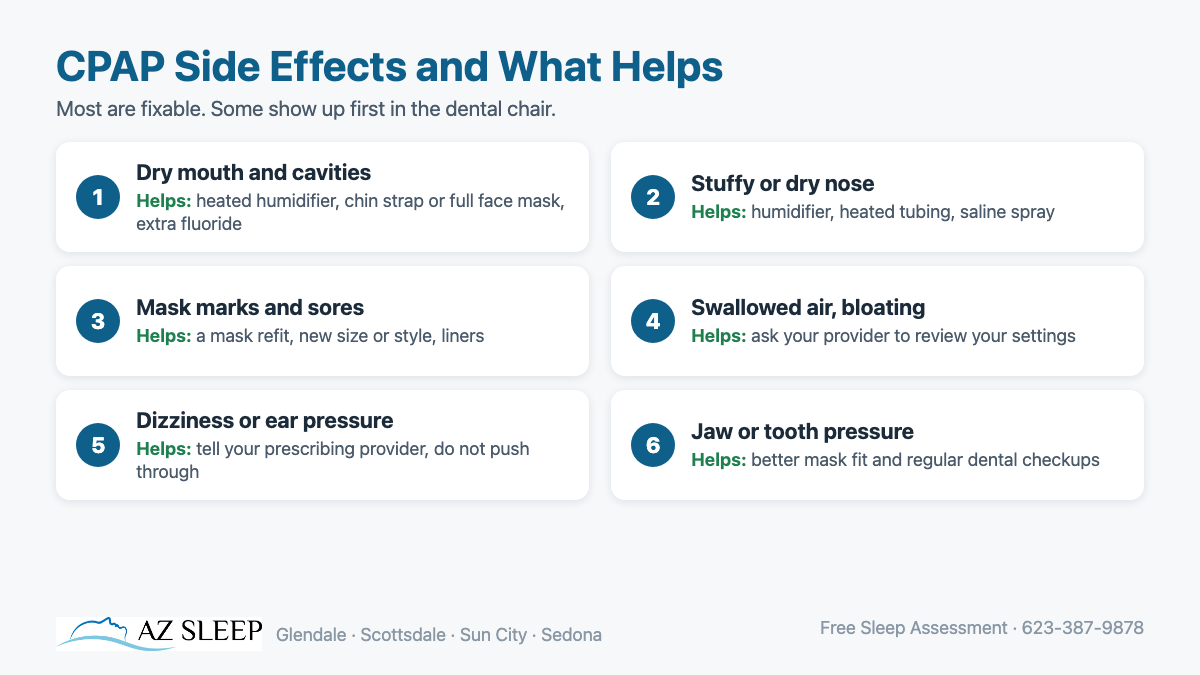
Here are the issues patients describe most often. You may have one of these or several.
Dry mouth and dry nose
This is the big one. If your mouth falls open during the night, air from the machine rushes out through your lips and dries everything out. You wake up with a tongue that feels like sandpaper and a throat that needs a full glass of water. Dry nasal passages, nosebleeds and a stuffy nose are common too, especially in dry climates like ours.
Nasal congestion and sinus pressure
Some people get a runny or stuffy nose from the airflow. Others feel pressure in the sinuses or ears, especially when they first start.
Mask marks, skin irritation and sores
A mask that’s too tight, the wrong size or the wrong style can leave red lines, irritate the skin, or rub a sore spot on the bridge of the nose.
Swallowed air and bloating
Some people swallow air during the night (the medical term is aerophagia). They wake up bloated, gassy or with stomach discomfort.
Dizziness or lightheadedness
Some patients tell me they feel dizzy or lightheaded, or notice ear pressure, especially in the early weeks or after a pressure change. This isn’t something to push through quietly. Let your prescribing provider know, because it’s worth checking your settings and ruling out other causes.
Claustrophobia and anxiety
For some people, having something strapped over the nose and mouth triggers a closed in, panicky feeling. That’s a real reaction, not a weakness, and there are ways to work through it.
Leaks, noise and eye irritation
Air leaking from the top of a mask can blow into your eyes and dry them out. Leaks also make noise that can wake you or your partner.
CPAP Side Effects Your Dental Team Sees First
This is where my chairside experience comes in. Your mouth tells a story about your nights, and I’ve learned to read it.
Dry mouth leads to cavities
Saliva is your mouth’s natural protection. It rinses away food, neutralizes acid and helps repair the early stages of tooth decay. When your mouth is dry for seven or eight hours every night, that protection is gone. Over months, I may see new cavities along the gumline or around old fillings and crowns, even in someone with great home care.
Irritated or inflamed gums
Dry tissue gets irritated more easily. Gums can look red, puffy or tender, and people with existing gum disease may notice it getting harder to control.
Bad breath and a coated tongue
A dry mouth lets bacteria settle in. Morning breath gets worse, and the tongue can look coated.
Pressure on the teeth and jaw
Masks and straps put steady pressure on the face every night. Some patients notice soreness around the jaw joint, especially with full face masks or chin straps that push the jaw back. Some research has suggested that years of mask pressure may subtly change how the upper front teeth and jaw sit. It’s not something everyone experiences, but it’s one more reason a good mask fit matters, and one more reason to keep up with regular dental visits.
Clenching and grinding
I also look for signs of clenching or grinding, like worn edges, small chips and sore chewing muscles. These can show up alongside sleep apnea, and they’re worth mentioning to both your dental team and your sleep provider.
If your hygienist has asked you lately whether your mouth feels dry, or pointed out new decay, it’s worth connecting those dots to your CPAP and talking about it.
How to Fix the Most Common CPAP Side Effects
Please don’t change your machine’s pressure settings on your own. Settings are part of your prescription. But many fixes are simple and well worth asking your prescribing provider or equipment supplier about.
- Heated humidifier and heated tubing. Adding moisture to the air is one of the most effective fixes for dry mouth and nose.
- A chin strap or a full face mask. If your mouth falls open, a chin strap or a mask that covers both nose and mouth can stop air from escaping.
- A mask refit. Different sizes, nasal pillows, cushions and liners can stop leaks and pressure sores. Many people are wearing the wrong size and don’t know it.
- Saline spray or rinse. Can help with nasal dryness and congestion.
- Ramp settings. Many machines can start at a lower pressure and build up as you fall asleep. Ask your provider whether this is turned on.
- Practice while awake. For claustrophobia, wearing the mask for short periods while reading or watching TV can help you get used to it.
- Clean equipment. A clean mask seals better and is gentler on your skin.
Protecting your teeth and gums
- Tell your dental team you use CPAP so they know to watch for dry mouth changes.
- Ask about prescription strength fluoride toothpaste or other options to protect against decay.
- Sip water during the day and limit sugary drinks, especially before bed.
- Ask about saliva substitutes or dry mouth products if dryness is constant.
- Keep up with regular cleanings so small problems stay small.
When CPAP Side Effects Mean It’s Time to Look at Other Options
Sometimes you can fix every issue on the list and still find CPAP hard to live with. That’s not a failure. It’s information. The real goal is to treat your sleep apnea every night, and there’s more than one way to get there.
For adults with mild to moderate obstructive sleep apnea, and for people who can’t tolerate CPAP, oral appliance therapy is a recommended treatment. A custom oral appliance holds your lower jaw slightly forward to keep your airway open. There’s no mask, no hose and no air blowing into a dry mouth. For severe sleep apnea, CPAP is usually the first choice, but an appliance can still be considered when CPAP isn’t working for you. Other options include positional therapy, weight loss and Inspire. I cover them all in my article on CPAP alternatives that actually work, and you can see an overview on our sleep apnea treatment options page.
One honest note: oral appliances can have side effects of their own, like temporary jaw soreness or changes in your bite over time. That’s why they need to be custom made and monitored by a dental sleep team, never bought off a shelf.
What Happens if You Just Stop Using CPAP?
This is the scenario that worries me most. When CPAP side effects pile up, many people simply stop. The machine goes in the closet and the sleep apnea goes back to work.
Untreated obstructive sleep apnea is linked to high blood pressure, heart disease, stroke, daytime sleepiness and a higher risk of drowsy driving accidents. The National Heart, Lung, and Blood Institute has a clear summary of these risks. Stopping treatment doesn’t make the condition go away. It just makes it invisible again.
If you’ve already stopped, you’re in good company, and there’s no judgment here. The next step is simply to get back into a plan you can keep.
How AZ Sleep Can Help
Here’s how the process works with us, in the same order for every patient:
- Free Sleep Assessment. Take our short online screening questionnaire at the Free Sleep Assessment page, or call 623-387-9878.
- Visit with our nurse practitioner. A medical visit billed under your medical insurance. Only a medical provider can prescribe a sleep study; dentists cannot.
- Home sleep test. A disposable, FDA-cleared device you use in your own bed and keep. Nothing to return.
- Diagnosis. Our nurse practitioner reviews your results and makes the diagnosis.
- Complimentary consult. Only after diagnosis, you meet with our dental sleep team for a complimentary consult about oral appliance therapy.
- Custom appliance and follow-up test. If it’s a good fit, we make and adjust your appliance, then confirm it’s working with a follow-up test.
We accept Medicare and medical insurance and see patients Monday through Thursday, 9am to 5pm, at our four Arizona locations.
Frequently Asked Questions
Is dry mouth from CPAP bad for my teeth?
It can be. Saliva protects your teeth from decay, so a mouth that’s dry every night is more prone to cavities and gum irritation. A heated humidifier, a chin strap or full face mask, and extra fluoride protection can all help. Let your dental team know you use CPAP.
Can CPAP make you dizzy?
Some people report feeling dizzy or lightheaded, or notice ear or sinus pressure, especially early on or after a pressure change. Don’t ignore it. Tell your prescribing provider so your settings can be reviewed and other causes ruled out.
Do CPAP side effects go away?
Many do, especially once the mask fit and humidity are right. Skin irritation and bloating often improve with adjustments, and many people adapt over the first few weeks. If side effects keep you from using CPAP, it’s time to talk about alternatives.
Can CPAP move my teeth?
Some research has suggested that long term mask pressure may cause small changes in how the front teeth and jaw sit. It doesn’t happen to everyone. A well fitted mask and regular dental checkups are the best way to keep an eye on it.
Is an oral appliance better than CPAP?
Not better for everyone. CPAP is very effective when it’s worn. An oral appliance is a recommended option for mild to moderate obstructive sleep apnea and for people who can’t tolerate CPAP. Our nurse practitioner’s diagnosis and a consult with our dental sleep team help sort out which fits you.
CPAP side effects wearing you down? Let’s talk about it.
You shouldn’t have to choose between a dry, sore mouth and treating your sleep apnea. Take your Free Sleep Assessment, or call 623-387-9878 to schedule with our nurse practitioner at any of our four Arizona locations.
Want to keep learning first? Browse our patient education library for more plain-English answers about sleep and airway health.
Your mouth and your sleep are more connected than most people realize. If CPAP is leaving you dry, sore or frustrated, that’s worth fixing, and you have more options than you might think.
Ready to find out what’s happening with your sleep?
It starts with our Free Sleep Assessment: a few quick screening questions, at no cost and with no referral needed. Medicare and medical insurance accepted.
Free Sleep Assessment
or call 623-387-9878 · Glendale · Scottsdale · Sun City · Sedona

Author: Joanna Booher, RDH
25+ years in dentistry · Airway educator with Awaken2Sleep · Licensed Dental Hygienist, AZ #H05418 (verify) · LinkedIn