
By Joanna Booher, RDH | 25+ years in dentistry | Airway educator with Awaken2Sleep
Patients ask me all the time about how to prevent sleep apnea. Sometimes it’s because a parent or spouse has it and they’re worried they’re next. Sometimes they’ve started snoring and want to stop it before it turns into something more. And sometimes they’ve read something online promising a quick fix and want to know if it’s real.
I’ve been in dentistry for more than 25 years and teach airway health through Awaken2Sleep, so I’ll give you the honest version. Some things genuinely lower your risk or make sleep apnea less severe. Some things are popular but don’t do much. And some things are flat out myths. Let’s sort them into those three piles.
Can You Actually Prevent Sleep Apnea?
Here’s the truth: you can’t prevent every case. Obstructive sleep apnea happens when the airway partly or fully collapses during sleep, and a lot of what makes an airway prone to collapse is built in. The size and position of your jaw, the shape of your palate, the size of your tongue and tonsils, your family history, your age and, for women, menopause all play a role. You can’t change most of those.
What you can change are the things that put extra pressure on that airway or make it more likely to relax and close. Think of it like this: some people are born with a narrower hallway. You can’t widen the walls, but you can keep from stacking boxes in it.
So when we talk about how to prevent sleep apnea, we’re really talking about two goals. First, lowering your risk of developing it. Second, keeping mild sleep apnea from getting worse. Both are worth the effort.
How to Prevent Sleep Apnea: Habits That Genuinely Lower Your Risk
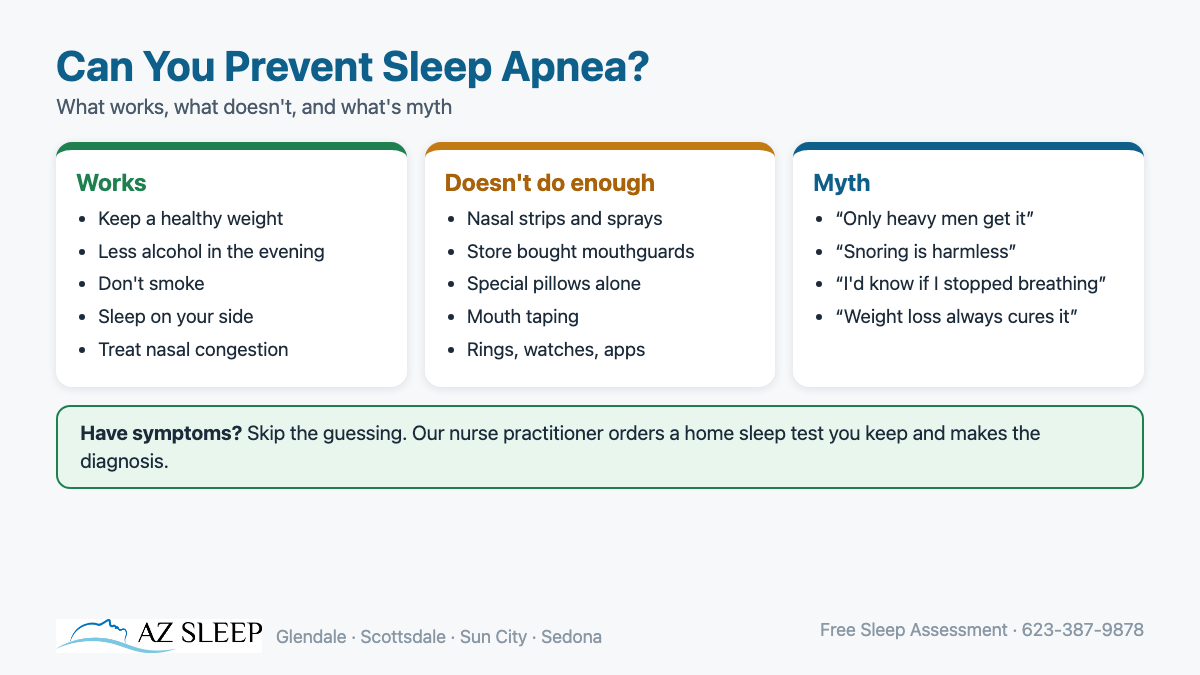
These are the steps with real support behind them. None of them guarantee you’ll never have sleep apnea, but each one takes some strain off your airway.
Keep a healthy weight
Excess weight is one of the strongest known risk factors for obstructive sleep apnea. Extra tissue around the neck and tongue can narrow the airway, and weight around the midsection can reduce lung volume, which makes the airway easier to collapse. Gaining weight tends to raise risk, and losing weight can reduce how severe sleep apnea is for many people.
If you’re curious where you stand, our BMI calculator is a quick starting point. And because poor sleep can also make weight harder to manage, I explain that two-way street in our article on sleep apnea and weight gain.
Go easy on alcohol, especially in the evening
Alcohol relaxes the muscles in your throat. That’s great for unwinding and terrible for an airway that’s already prone to collapsing. Drinking in the hours before bed can make snoring louder and breathing pauses more frequent. If you drink, having it earlier in the evening is kinder to your airway.
Be cautious with sedatives and sleep aids
Some sleep medications, sedatives and pain medications can relax the airway or reduce your body’s drive to breathe. Never stop a prescription on your own, but do ask your medical provider whether anything you take could affect your breathing at night.
Don’t smoke
Smoking irritates and inflames the tissues of the nose and throat, which can add swelling to an airway that doesn’t have room to spare. Quitting is good for your whole body, your airway included.
Sleep on your side
For many people, the airway collapses more easily when they sleep flat on their back, because gravity pulls the jaw and tongue backward. Side sleeping can reduce snoring and, for some people, reduce breathing events. A body pillow behind your back can help you stay there.
Keep your nose clear
Allergies, a deviated septum or chronic congestion can push you into breathing through your mouth at night. Mouth breathing lets the jaw drop open and the tongue fall back. Treating allergies and congestion with your medical provider’s help won’t cure sleep apnea, but it can make nighttime breathing easier. I go into more detail in my article on mouth breathing at night.
Stay active and protect your sleep schedule
Regular physical activity supports a healthy weight and better sleep overall. And being badly sleep deprived can make your airway muscles more floppy when you finally do sleep. Aim for a consistent bedtime and enough hours; most adults need seven or more.
Pay attention to children’s airways
If you’re a parent or grandparent, this one matters. In children, enlarged tonsils and adenoids are a common cause of sleep apnea. Snoring, mouth breathing, restless sleep and daytime behavior problems in kids are worth bringing up with their pediatrician. As a hygienist, I also notice crowded teeth and narrow palates in kids, and early conversations with their dentist and pediatrician can help.
What Doesn’t Work (or Doesn’t Do Enough)
These products and ideas are popular, and some may make snoring a little quieter. But none of them treat or prevent sleep apnea, and some can give you a false sense of security.
Nasal strips and throat sprays
Nasal strips can open the nostrils slightly, and some people find them comfortable. But sleep apnea usually happens further back, where the tongue and soft tissues of the throat collapse. Strips and sprays may soften snoring without touching the actual problem.
Over the counter mouthguards
Boil and bite snoring devices sold online or in stores aren’t custom fitted or adjusted by a dental sleep team. They can be uncomfortable, they may not hold the jaw in an effective position, and some people find they cause jaw soreness or bite changes. More importantly, using one without a diagnosis can quiet the snoring while sleep apnea continues underneath.
Special pillows
A pillow that keeps you on your side may help a bit with positional snoring. But no pillow can treat sleep apnea on its own.
Mouth taping
Taping your mouth shut at night has become popular on social media. I’d urge caution. It’s not a proven treatment for sleep apnea, and if your nose is congested or your airway is already struggling, it could make breathing harder. Talk to a medical provider before trying it.
Tracking gadgets
Smart rings, watches and snoring apps can be interesting, but they are not a diagnosis. A good score on a gadget doesn’t mean you don’t have sleep apnea, and a bad one doesn’t mean you do.
A note on airway exercises
You may have heard of myofunctional therapy, which uses exercises for the tongue, lips and throat. Some research suggests these exercises may help reduce snoring and mild sleep apnea in some people. I’m a fan of airway education, but these exercises are not a substitute for testing and proper treatment.
Sleep Apnea Myths I Hear All the Time
Part of learning how to prevent sleep apnea is unlearning what isn’t true. These myths keep people from getting checked.
- Myth: Only overweight men get sleep apnea. Weight and being male raise risk, but plenty of thin people and plenty of women have it. Women’s symptoms are often fatigue, insomnia, headaches or anxiety rather than loud snoring.
- Myth: Snoring is harmless. Sometimes it is. But loud, frequent snoring is also one of the most common signs of sleep apnea. It deserves a closer look, not a joke. You can read more in our article on snoring treatment.
- Myth: If I stopped breathing, I’d know. Most people with sleep apnea don’t remember the awakenings. They just wake up tired.
- Myth: Losing weight always cures it. Weight loss can help a lot, but it doesn’t cure everyone, because anatomy plays a big role. Retesting is the only way to know.
- Myth: I’m too young. Sleep apnea can happen at any age, including in children.
- Myth: Sleep apnea is just a snoring problem. Untreated obstructive sleep apnea has been linked with high blood pressure, heart disease, stroke and type 2 diabetes.
When Prevention Isn’t Enough: Signs It’s Time to Get Tested
Knowing how to prevent sleep apnea is worth it, but healthy habits are not a reason to skip testing if you already have symptoms. The National Heart, Lung, and Blood Institute’s overview of sleep apnea symptoms and risk factors is a helpful reference. Signs to watch for include:
- Loud snoring most nights
- A partner noticing pauses in your breathing
- Waking up gasping or choking
- Waking with a dry mouth, sore throat or headache
- Feeling tired no matter how long you sleep
- Getting up to urinate during the night
- Blood pressure that’s hard to control
From my side of the dental chair, I also pay attention to worn teeth from grinding, a scalloped tongue, a crowded throat and signs of mouth breathing. These clues don’t diagnose anything, but they’re a good reason to ask questions.
How Testing and Treatment Work at AZ Sleep
If you have symptoms, the best thing you can do is find out for sure. Here’s how the process works at all four of our Arizona locations.
- Free Sleep Assessment. Start with our short online screening questionnaire on our Free Sleep Assessment page, or call 623-387-9878.
- Visit with our nurse practitioner. This is a medical visit, billed under your medical insurance. Only a medical provider can prescribe a sleep study; dentists cannot.
- Home sleep test. If testing makes sense, our nurse practitioner orders a disposable, FDA-cleared home sleep test. You sleep in your own bed, and the device is yours to keep, so there’s nothing to return.
- Diagnosis. Our nurse practitioner reviews the results with you and makes the diagnosis.
- Complimentary consult, only after diagnosis. If you’re diagnosed with sleep apnea and an oral appliance may be a fit, you’ll meet with our dental sleep team for a complimentary consultation.
- Custom appliance and follow-up test. If you move forward, we make a custom oral appliance and then test again to confirm it’s working.
Custom oral appliances are an AASM-recommended treatment for mild to moderate obstructive sleep apnea and for people who can’t tolerate CPAP. For severe sleep apnea, CPAP is usually the first choice. Weight loss, side sleeping, a hypoglossal nerve stimulator such as Inspire, and surgery may also be options depending on your diagnosis. We accept Medicare and medical insurance, and our offices are open Monday through Thursday, 9am to 5pm.
Frequently Asked Questions
What is the best way to prevent sleep apnea?
There’s no single guaranteed method, because anatomy and genetics play a big role. Keeping a healthy weight, limiting alcohol in the evening, not smoking, sleeping on your side and keeping your nose clear all lower the strain on your airway.
Can sleep apnea go away on its own?
It usually doesn’t. In some people, weight loss or treating a specific cause, like enlarged tonsils in children, can reduce or resolve it. The only way to know is to retest.
Will losing weight cure my sleep apnea?
It may help a great deal, and for some people it’s enough. But many people still have sleep apnea after weight loss because of the structure of their jaw and airway. A follow-up sleep test tells you where you stand.
Do over the counter snoring mouthguards prevent sleep apnea?
No. They may reduce snoring for some people, but they don’t diagnose or reliably treat sleep apnea, and they can quiet the snoring while the breathing problem continues. A custom appliance should only be made after a diagnosis.
If my parent has sleep apnea, will I get it?
Not necessarily, but family history does raise your risk, partly because jaw and airway shape run in families. If you have symptoms, get screened rather than waiting.
Healthy habits are a great start. Knowing for sure is better.
If you snore, wake up tired, or have a family history of sleep apnea, find out where you stand. Take your Free Sleep Assessment, or call 623-387-9878 to schedule with our nurse practitioner at any of our four Arizona locations.
Medicare and medical insurance accepted.
Learning how to prevent sleep apnea is really about giving your airway the best chance it can have every night. Do what you can control, stay honest about the symptoms you can’t ignore, and if something feels off, get tested. Answers are easier to live with than questions.
Ready to find out what’s happening with your sleep?
It starts with our Free Sleep Assessment: a few quick screening questions, at no cost and with no referral needed. Medicare and medical insurance accepted.
Free Sleep Assessment
or call 623-387-9878 · Glendale · Scottsdale · Sun City · Sedona

Author: Joanna Booher, RDH
25+ years in dentistry · Airway educator with Awaken2Sleep · Licensed Dental Hygienist, AZ #H05418 (verify) · LinkedIn